
- 07 Sep, 2026
- 0 Comments
- 13 Mins Read

French Tutor
French Tutor
Apex Academic Centre is looking for French tutors to teach online across South Africa, from school learners taking French as a subject to adults learning it from scratch. You set your own hours, we bring you the learners.
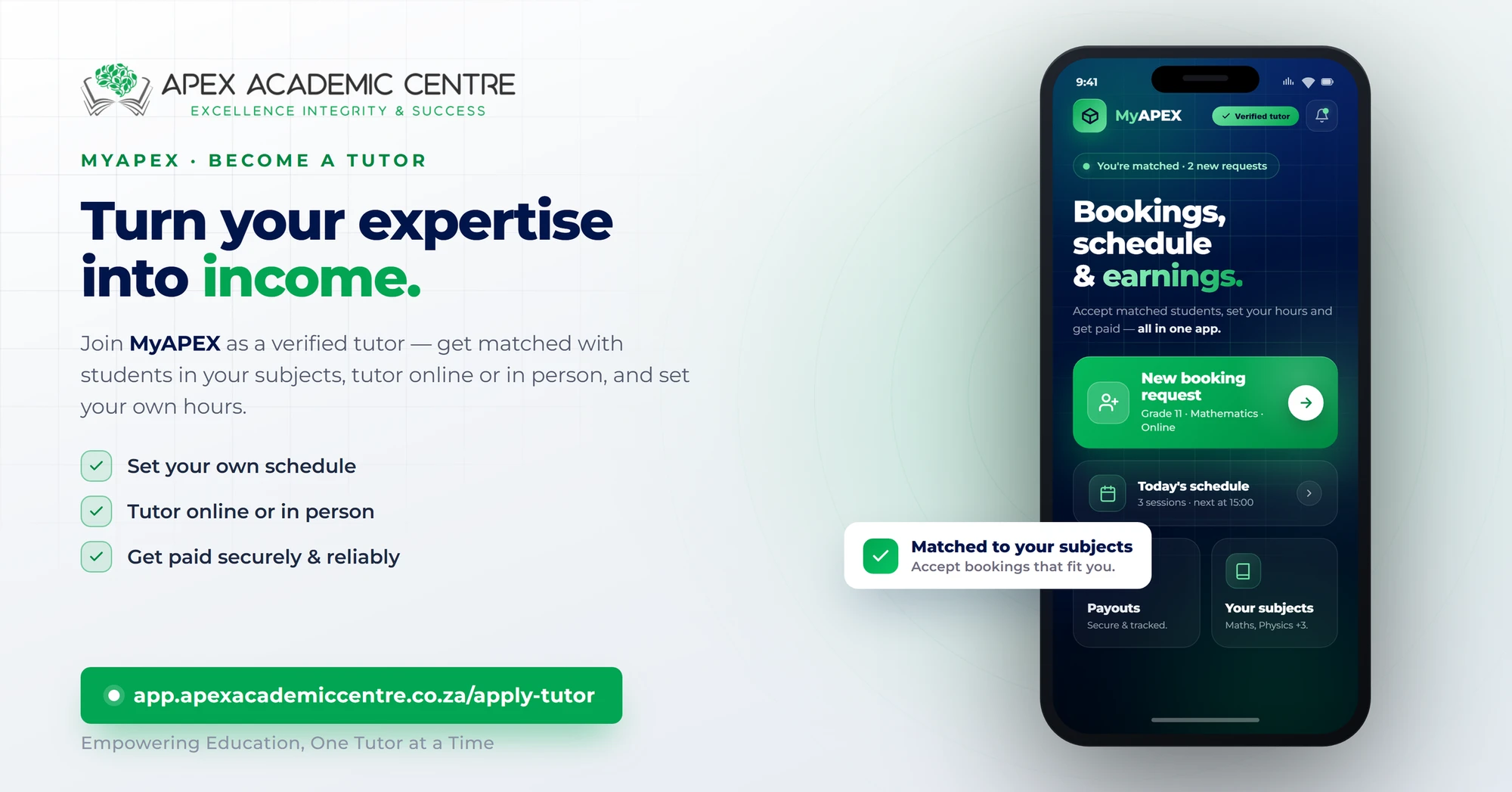
MyAPEX · Become a tutor
This is an ongoing opening. French is the language we are asked for most often after the South African languages, and demand is spread across the country rather than concentrated in one city, which is exactly the problem online tutoring solves.
About the role
French learners reach Apex from three directions: school learners taking it as an additional language and needing help with grammar and oral assessment, learners preparing for a recognised proficiency examination, and adults learning for travel, work or emigration.
You would teach one to one, online, on Apex’s own platform. Lessons are booked through MyAPEX and you accept the requests that fit your diary. Language work tends to produce steady weekly bookings over months rather than short exam pushes.
What you would be doing
-
Teaching French one to one across listening, speaking, reading and writing, pitched at the level the learner is actually at.
-
Preparing learners for oral assessment, which is where school learners most often lose marks and where one to one tutoring has the greatest advantage over a classroom.
-
Teaching pronunciation properly and early. French pronunciation is systematic, and a learner who is never corrected in the first months builds habits that are hard to undo.
-
Working to the learner’s own syllabus where they are taking French for a formal school qualification, rather than teaching a general course alongside it.
-
Giving real speaking time in every lesson, rather than talking about the language in English.
-
Keeping communication on the platform. All lesson communication and homework runs through MyAPEX, which is how Apex keeps a record for the parent and the learner.
What we need from you
Near-native or native fluency in French, spoken and written.
Teaching experience. Speaking a language and teaching it are different skills, and learners can tell the difference within one lesson.
A relevant qualification. A teaching qualification, a degree in French, or a recognised language teaching certificate.
An advantage, not a requirement: SACE registration. Many of the strongest tutors are graduates, postgraduates or subject specialists rather than registered schoolteachers. Where you do hold SACE registration, Apex verifies it and shows it on your profile, and parents do look for it.
A police clearance certificate if you tutor in person. Apex requires one for in-person tutoring. It is not required to tutor online, and you can add it later if you decide to teach face to face.
A laptop or desktop, a webcam, a stable internet connection and a quiet room to teach from. Apex checks all four. Audio quality matters more for languages than for any other subject.
Helpful but not required: experience preparing learners for a recognised French proficiency examination, and experience with young beginners.
What Apex verifies before your first lesson
Verification is a condition of engagement
Apex verifies who you are and what you are qualified to teach before you take a booking. A self-declaration is not enough, which is why we ask for documents rather than assurances. What is checked depends on how you teach: in-person tutoring carries one additional requirement, because the lesson happens face to face.
- Identity. Your ID or passport, and that the name on it matches your qualifications
- Qualifications. The certificates behind the subjects and levels you want to teach
- Police clearance. Required for in-person tutoring
- SACE and other credentials. Verified and shown on your profile where you hold them, as an advantage rather than a requirement
- Equipment. Machine, camera, connection and teaching room
Screening is a continuing condition, not a once-off. The detail sits in clause 4 of the Tutor Terms and Conditions, and there is a full walkthrough in What it means to be a verified Apex tutor.
How the work reaches you
Learners come to you
You are matched on subject, curriculum and the hours you have actually marked as available. You accept or decline each request.
Paid on the 2nd
Tutor fees are paid monthly, on the 2nd of the month, per lesson actually delivered. If a date falls on a weekend or public holiday, it moves to the next business day.
You set the hours
No minimum, no fixed timetable. You tutor as an independent contractor and you decide how much work you take.
Questions tutors ask before applying
No. Applications are made through MyAPEX, where you build a tutor profile once: your subjects, your curricula, your qualifications and your availability. Apex no longer accepts CVs or applications by email, because the profile is what parents read when they choose a tutor.
Apex tutors are independent contractors, not employees. You set your own hours, you accept the bookings you want, and you are responsible for your own tax and statutory obligations. This is set out in the Tutor Terms and Conditions you accept when you register.
No. Many Apex tutors are graduates, postgraduates or subject specialists rather than schoolteachers, and SACE registration is an advantage rather than a requirement. What matters is that you can teach the language, not only speak it. Fluency alone is not enough, and it is the most common reason a language application does not go anywhere.
Yes, if you are good at it, and say so on your profile. Primary age language teaching is a distinct skill and parents specifically look for tutors who can do it.
You complete your profile on MyAPEX and upload your documents. Apex verifies them, and once you are cleared your profile goes live and you start receiving matched requests in your subjects. You are not charged anything to apply or to be listed.
Ready to join the Apex tutor team?
Apply through our MyAPEX platform. Create your tutor profile once and we will match you with learners in your subjects as new jobs come in. We no longer accept CVs or applications by email.