
- 21 Sep, 2026
- 0 Comments
- 25 Mins Read

Exam Day Checklist: What to Bring and What Is Not Allowed
Exam preparation
Exam Day Checklist: What to Bring and What Is Not Allowed
Most exam day advice online is invented. This is not: every rule below is quoted from the assessment body’s own published document, and where a board does not publish one, this page says so rather than filling the gap.
 For matriculants and parents
What should be on your exam day checklist?
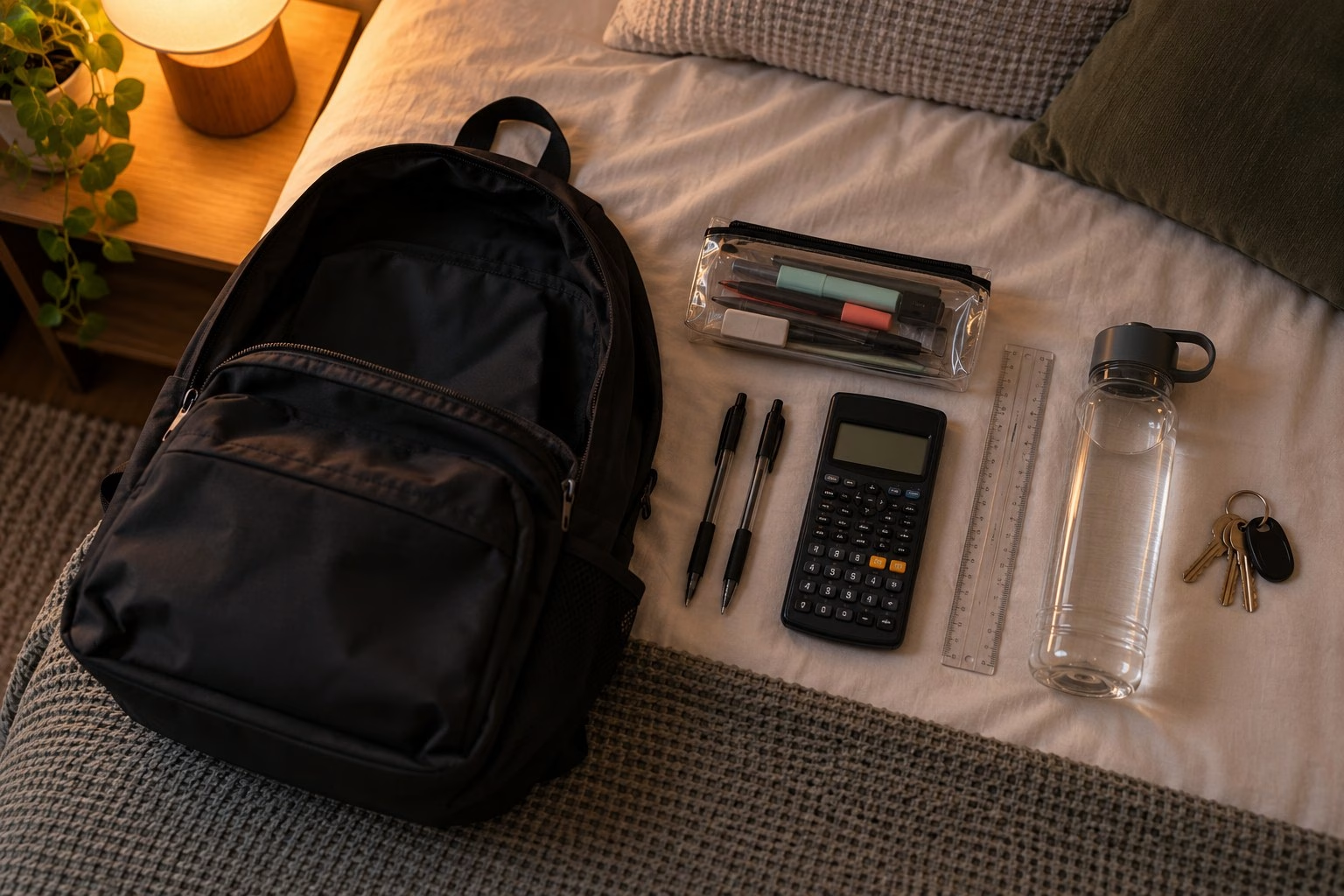
Your letter of admission and proof of identity, black pens, an approved calculator where the paper allows one, a ruler, and water. Leave behind anything that communicates: phones, smart watches, earphones and smart glasses are named as prohibited by more than one board. The permit issued by your examination centre is the authority on your own papers, and no checklist on any website outranks it.
The reason this page is shorter on confident instructions than most is deliberate. Every rule below is taken from the assessment body’s own document, and there are places where a board simply does not publish a public rule. Those are marked rather than filled in. If the subject rather than the stationery is the worry this week, you can book a verified tutor on the MyAPEX app.
What do the CAPS rules actually say?
More than most people realise. The Department of Basic Education’s published regulations set ten minutes of reading time before a paper starts, during which no writing of any kind may take place. A candidate may be admitted late only in exceptional circumstances and not after an hour has passed. No candidate may leave during the first hour. Every candidate must produce a letter of admission and proof of identity, and must sign an attendance register for each subject.
Those come from the Regulations pertaining to the conduct, administration and management of the National Senior Certificate examination, published in Government Gazette 31337 and amended since, on the Department’s own website.
| Rule | What the regulations say |
|---|---|
| Reading time | Ten minutes before the official start, with no writing of any kind during it |
| Arriving late | Admission after the start only in exceptional circumstances, and not after an hour has passed |
| Leaving early | Not during the first hour of the session. Leaving temporarily only in an emergency |
| Documents | Letter of admission and proof of identity, produced on admission to the room |
| Phones | Equipment not required for the examination, including cell phones, may not be in the room |
| Calculators | Only calculators as approved and prescribed, except where the paper prohibits them |
| At the end | All aids, scripts and answer sheets handed in before leaving the room |
The regulations also say that general examination instructions are given to candidates in writing at the start of the examination, and that each candidate signs to confirm receipt. Read that sheet rather than skimming it.
What happens if you forget your ID or arrive late?
Forgetting your documents is not the disaster it feels like. The regulations say a candidate who fails to produce the required documentation will be allowed to sit the examination, but must present it to the invigilator afterwards; only if that fails does the irregularity procedure begin. Arriving late is more serious: admission after the start is possible only in exceptional circumstances, and not at all once an hour has passed.
So the priority on the morning is arriving, not assembling the perfect bag. If something has been left at home, go anyway and tell the invigilator. If transport has failed and you are going to be late, phone the centre while you are still travelling rather than after you arrive.
The hour cuts both ways. You cannot be admitted after an hour has passed, and you cannot leave during the first hour either. For a three-hour paper written at 09:00, that means you are in the room from 09:00 to at least 10:00 whatever happens, so settle in rather than planning around an early exit.
What do Cambridge and Pearson Edexcel prohibit?
Both name the items rather than describing them vaguely. Cambridge’s own notice to candidates says you must not have unauthorised materials “such as watches, mobile phones, earphones, smart glasses and notes” in your possession. The instructions Pearson publishes list AirPods, earphones and earbuds, iPods, mobile phones, MP3 and MP4 players, watches, smart glasses and any other smart devices, and require that any pencil case taken in is see-through.
Two details worth knowing. Watches are on both lists, which surprises people every year; there is a clock in the room and your own watch is not needed. And the see-through pencil case rule is the reason the clear plastic ones exist. Sources: Cambridge’s Notice to candidates and its Information for candidates, and the instructions for conducting examinations published on qualifications.pearson.com.
Cambridge has one rule the others do not. After the paper you must not discuss the content with any other candidate until the Key Time or the end of the assessment window has passed. Because Cambridge runs across many time zones, a conversation in a corridor can reach a candidate who has not yet written. Take that one seriously.
The edition of the Pearson document currently published covers the 2024 to 2025 examination year, so confirm the current version through your centre rather than treating the list here as this session’s final word.
What about IEB and IB candidates?
Neither publishes a candidate rule sheet openly, so the honest answer is to get it from your school. The IEB distributes its examination regulations and instructions to candidates through registered schools rather than on its public website. The IB’s exam calculator policy page says approved calculator information sits in the Programme Resource Centre, which only authorised schools can access, so your Diploma Programme coordinator is the source.
This is not a gap in the research. It is how those two bodies distribute candidate rules, and it means a document you find on some other school’s website is not necessarily the version that applies to you. Ask for your own school’s copy, and read it rather than assuming it matches what a friend at another school was told.
What does apply to every IEB candidate is the same practical point as everyone else: the examination permit and the school’s own instructions govern your morning. More on how the two routes differ is in CAPS vs IEB exam preparation.
What goes in the bag, and what stays home?
In: the letter of admission or permit, proof of identity, several black pens, pencils, an eraser and a sharpener in a see-through case, a ruler, an approved calculator where the paper allows one, and water in a clear bottle. Out: phone, smart watch, ordinary watch, earphones, earbuds, smart glasses, notes of any kind, and anything else that stores or transmits information.
- Pack the night before. Not at seven in the morning, when anything missing becomes a crisis rather than an errand.
- Spare pens. Two that work is one that works plus a spare.
- The calculator you have used all year. Exam day is the wrong day for a borrowed model with different menus, and the paper itself tells you whether one is allowed.
- Clear everything from the calculator. Stored notes or programs are unauthorised material.
- Water with the label off. Many centres require it, and it costs nothing to do.
- Leave the watch. There is a clock in the room, and watches are explicitly named by more than one board.
What to eat before a morning or afternoon paper is covered separately in exam season eating, and the night before is in sleep before exams.
Why is the permit the final word?
Because it is the only document written for your papers, at your centre, in your session. Timetables move, venues change, and a rule that applies to one board does not apply to another. Every board’s own material says some version of the same thing: follow the instructions of the invigilator and the centre. A checklist on a website, including this one, is preparation rather than authority.
Check the permit against the published timetable early enough to query anything that looks wrong, which is one of the jobs in our parent guide to the four weeks before the exams. The dates themselves are in the matric exam timetable 2026.
Where does Apex Academic Centre fit in?
Not on exam day. Apex Academic Centre is a tutoring provider, not an examination centre: it does not issue permits, set timetables, invigilate or decide what may be carried into a room. Those belong to the Department of Basic Education, the IEB, Cambridge, Pearson Edexcel, the IB and your own centre. What Apex does is the weeks before, matching a learner to a verified tutor in the subject that is costing marks.
If you have a question about a rule on this page, your examination centre can answer it and we cannot. If you have a question about trigonometry, book a tutor on MyAPEX or see the subjects offered. No tutoring service can promise a mark, and Apex does not.
Frequently asked questions
What can you take into a matric exam?
Your letter of admission and proof of identity, black pens, pencils and an eraser in a see-through case, a ruler, an approved calculator where the paper allows one, and water. The Department of Basic Education’s regulations require the letter of admission and proof of identity to be produced on admission to the examination room.
Are watches allowed in exams?
Not for Cambridge or Pearson Edexcel candidates, both of which name watches among prohibited items alongside mobile phones, earphones and smart glasses. There is a clock in the examination room. For CAPS and IEB papers, confirm with your centre, since the rule is applied by the assessment body and the centre.
How much reading time do you get in a matric exam?
Ten minutes before the official commencement, on the Department of Basic Education’s published regulations, and no writing of any kind may take place during it. Use it to read the whole paper and decide the order you will answer in, rather than starting to plan an answer on paper.
What happens if you arrive late for a matric exam?
The regulations allow admission after the start only in exceptional circumstances, and not once an hour has passed. Phone the examination centre while you are still travelling rather than after you arrive. Candidates also may not leave the room during the first hour of the session.
What if you forget your ID on exam day?
Go anyway and tell the invigilator. The regulations say a candidate who fails to produce the required documentation will be allowed to sit the examination but must present it to the invigilator afterwards, and only if that fails does the irregularity procedure begin. Arriving is more important than the paperwork.
Pack it the night before
The permit governs the morning. We handle the weeks before it.
Rules come from your board and your centre. Closing the gap in the subject that is losing marks is what a verified Apex tutor is for.